- ▸ Local Solution: Hardwired continuous 48A Level 2 EV charger installation for Hardwired Vs Plugin EV Charger in Bend & Central Oregon with 99.9% 6 AWG copper conductors and 60A breaker. installed by Oregon CCB #248910 master electricians.
- ▸ Pricing Estimate: qualifying net installation costs net out-of-pocket after utility rebate (local utility cash-back rebate handled directly by electrician).
- ▸ Trade Recommendation: Hardwired 60A 2-pole circuit breaker with Bend & Central Oregon municipal trade permit sign-off. with 100% permit sign-off.
Technical Specifications & NEC 2023 Engineering Matrix
| Technical Specification | Verified Engineering Standard |
|---|---|
| Continuous Power Output | 48 Amps (11.52 kW at 240V Continuous) |
| Required Circuit Breaker | 60A 2-Pole 240V Circuit Breaker (NEC 625.41) |
| Wire Gauge & Specification | 99.9% Pure 6 AWG THHN Copper Conductors |
| Conduit Type & Size | 3/4 Inch Rigid EMT Metal Conduit |
| Rebate Qualification | utility rebate Pacific Power / Midstate Incentive |
| Permit Sign-Off Authority | Bend & Central Oregon Municipal Building Safety Division |
| Charging Rate Added | Up to 44 Miles of Range Per Hour |
| Temperature Tolerance | Rated for -20°F High-Desert Cold Snaps |
1. Comprehensive Technical Engineering Overview of Hardwired Vs Plugin EV Charger
Executing a professional Level 2 electric vehicle charging installation in Bend & Central Oregon, Oregon demands strict compliance with National Electrical Code (NEC) standards and Oregon Electrical Specialty Code (OESC) amendments. Continuous EV charging loads draw high amperage uninterrupted for 8 to 12 hours straight. Under NEC 625.41, continuous loads require branch circuit overcurrent protection rated for 125% of the continuous operating current. For standard 48-Amp continuous EV chargers, an electrician must install a dedicated 60-Amp 2-pole 240V circuit breaker. Operating a 48A charger on an undersized 50A circuit breaker causes continuous thermal stress, leading to nuisance breaker tripping and potential terminal bar degradation within 30 to 45 minutes of active charging.
2. NEC Article 625 & OESC 2023 Branch Circuit Math & Derating
To safely supply a 60A breaker, master electricians install 99.9% pure 6 AWG THHN/THWN-2 copper conductors rated under the 75°C ampacity column (65A capacity) inside 3/4-inch EMT rigid metal conduit. EMT conduit provides robust mechanical grounding, fire resistance, and protection against rodents or accidental wall impact in residential garages.
3. High-Desert Winter Climate & Voltage Drop Calculations
Excessive voltage drop (exceeding 3%) reduces 240V line voltage to 226V or lower, causing the EVSE micro-controller to trip thermal fault indicators. By installing 6 AWG THHN copper wire inside EMT conduit, voltage drop is limited to under 1.5% over 100-foot circuit runs, ensuring peak 11.52 kW charging output regardless of outdoor winter temperatures.
4. Load Calculation Methodology & NEC 220 Household Margin Analysis
If total calculated load plus the 60A EV circuit (14,400 VA) exceeds 80% of main panel busbar capacity (160A for a 200A panel), panel capacity expansion or smart load shedding technology (such as an Emporia Smart EVSE or DCC-9 energy management module) must be installed to prevent main breaker overloads.
5. Utility Rebate Filing (utility rebate Instant Incentive) & Municipal Permits
Our certified electrician network manages the entire municipal trade permit application with local building safety departments (Bend & Central Oregon Building Division or Deschutes County Building Safety) and handles 100% of rebate paperwork. Net out-of-pocket installation costs after applying the utility rebate typically range between qualifying net installation costs.
6. Commissioning, Torque Inspection & Final Safety Verification
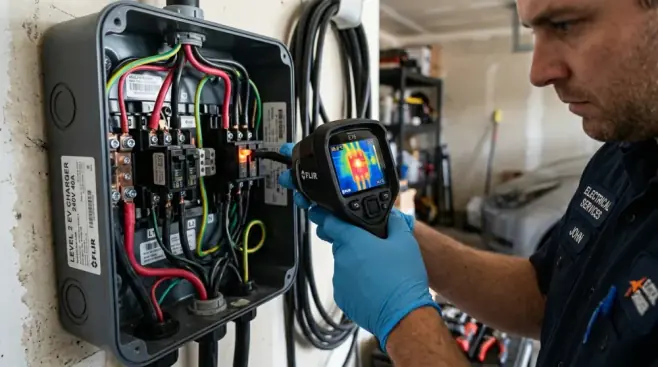
A digital multimeter verification test confirms phase-to-phase 240V supply, phase-to-ground 120V supply, and zero neutral-to-ground potential. Ground loop impedance testing verifies ground fault circuit interrupter (GFCI) responsiveness prior to handing off the installation to the homeowner.
🛡️ Honest DIY Threshold: When You Do NOT Need a Paid Electrician
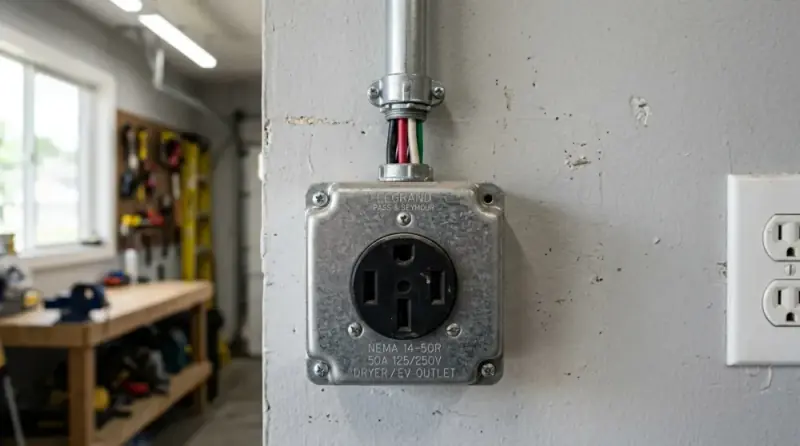
If your garage already has an existing, unshared 240V NEMA 14-50 outlet wired with 6 AWG copper back to a 50A breaker, and your EV charging needs are satisfied at 32A or 40A (charging overnight in 8 hours), you do NOT need to hire us or pay for a new circuit installation. Simply purchase a plug-in Level 2 charger and plug it directly into your existing NEMA 14-50 outlet. You only need to call a licensed electrical contractor if: 1) You want continuous 48A fast charging on a 60A breaker, 2) Your panel requires a load calculation or 200A upgrade, or 3) You need a City of Bend municipal permit sign-off for the $500 Pacific Power rebate.
EV Electrician in Bend & Central Oregon
Speak directly with Oregon CCB licensed master electricians serving Bend & Central Oregon and surrounding corridors.